26 April 2011

Beltane In A Week: The Faery Courts


As promised, here's a bit of information about the Faery Courts. Whether you believe in the fae or not, it'd still be good to know how they make an impact on the changing of the seasons... and who knows, maybe not seeing is believing!

Beltane is the first of three yearly Faery Realm festivals, with the other two being the eves of Midsummer (Litha) and Samhain. These dates, especially Beltane and Samhain, signal a great change in the Faerie Realm as the courts shift: Starting on Beltane eve, the Seelie Court reigns supreme, and on Samhain ege, the Unseelie Court takes over. The most significant difference between the two is compassion or lack thereof, as the Seelie Court tend to exhibit more compassion towards humans while the Unseelie Court outright refuses.


The Seelie Court


The term "seelie" is derived from the German selig meaning "blessed" or "holy", and Old English sælig meaning "silly". It can also be spelled from the Irish spelling seleighe. Obviously, then, the term itself would imply that those in the Seelie Court are more benevolent towards humans, while those in the Unseelie Court are quite the opposite.

Both Courts are capable of retaliation for an injury or insult, though, and are swift to do so. They both also borrow or steal items from humans, from your household keys to your cattle (well, provided you have cattle), and they're not above using humans for their own purposes, whatever those may be. Often, this is even without our knowledge.


Generally, Seelie faeries are often helpful and fair in dealing with us, returning things they borrow, showing gratitude for kindness we show them, showing delight in music and dancing, and displaying appreciation for neatness, order, beauty, and fertility.

Considering this, it makes complete sense that Beltane brings forth the Seelie Court, who emerge on this day to help us celebrate love, lust, and life. As explained in a previous Beltane post, one might look through a sprig of rowan twisted into a ring to seek the faeries at dusk... but beware that faeries, regardless of the Court, do not like to be watched!


Faerie Blessings and Practices


While faeries still do enjoy their carefree and mischievous ways of life, especially after a long winter's repose, Beltane often brings out the best in them. Requesting a blessing by leaving offers of bread and drink at your doorstep may leave you in their good favor. They enjoy the sweet harvests of fruits, candied roots, and aromatic spices, so breads made with dried fruit like raisins and candied peel, ginger, and cinnamon are sure to win them over. Be sure to not use any steel or iron, as they tend to detract the faeries.

Types of Faeries


Below the jump are types of Seelie Court faeries. You might find some to be very familiar, indeed!


    • Ballybogs: a type of Bogan that lives in peat bogs
    • Bean-Tighes: house faeries that look like kindly faced old peasant women
    • Biersals: house faeries that look after beer cellars
    • Bogans: a type of Hobgoblin that is very fond of tricks
    • Bodachan Sabhaills: house faeries that work at night threshing corn and that keep things tidy; live with and look like old men; are very wise
    • Browneys: faerie guardians of bees
    • Brownies: house faeries that do odd jobs about a house and farm, cleaning, tidying up, or helping with the brewing; usually go naked, dress in rags, or wear a brown hood and mantle; an offer of clothes will cause them to leave; if offended, they turn into Boggarts
    • Bruder Rausch: house faeries that delight in getting people drunk
    • Buachaileen: faeries that appear as young men wearing pointed red caps; like to play tricks on shepherds and their animals, but keep their own herds
    • Buschfrauen: golden haired faerie women that are small and shaggy with pendulous breasts and hollow backs; they live in hollow trees and guard the forests
    • Caryatids: nymphs that live in walnut trees
    • Centaurs: have the upper bodies of men and the lower bodies of other beasts, usually horses (hippocentaur), but sometimes donkeys (onocentaur) or even fish (ichthyocentaur)
    • Church Grims: live in church bell towers and delight in ringing the bell at midnight; may appear to the clergyman during a funeral, who can tell based on how the grim looks if the deceased soul was saved or lost; they guard the churchyard from the devil
    • Cluricauns: similar to Leprechauns, but overfond of raiding wine cellars and borrowing sheep and dogs to ride at night
    • Coblyn: mine faeries that do not actually mine anything, just pretend to; if spoken ill of, they will throw stones but never really hurt anyone; often guide miners to the best seams
    • Couril: little faeries with webbed feet that haunt ancient stone circles and standing stones
    • Dobies: house faeries fond of helping workmen at their tasks; unfortunately, they are so stupid they are more a hindrance than helpful
    • Doonies: faeries that appear in the form of a horse, an old man or old woman, and are generally helpful, even to the point of rescuing fallen climbers
    • Drakes: house/fire faeries that keep the firewood dry, bring gifts of gold and grain, take care of the house, barn and stables, and make sure the pantry and money chest are well stocked; smell like rotten eggs and take on the character of fire only when they fly, otherwise look like small boys with red caps and coats
    • Dryads: Nymphs that make their homes in oak trees
    • Dwarves: born of the Giant Ymir’s body, they are intelligent and have great strength; they are superb craftsmen and very wise; they mine precious stones and metals, guard the earth and its riches, and are spirits of rocks and caverns, kin to the Knockers and Coblyn
    • Elves: originally ancestral spirits that brought fertility; they are trooping faeries that live in companies ruled by a king or queen, and dwell underground or in certain groves
    • Epimeliads: nymphs that live in apple trees
    • Fadhas: small, lovely faeries that are generally friendly, will always return anything they borrow, and repair anything they break
    • Familiars: guardian faerie spirits, such as Haltias, Fylgiar, and Leanan Sidhe
    • Fantine: kindly faeries that bring good weather to farmers; they invented the cow-bell to keep cows from becoming lost
    • Fauni: gentler equivalent of the Satyr, mischievous woodland faeries with the heads and torsos of young men and the legs of goats or deer; they love to dance with Nymphs in woodland glades, play their flutes, and are guardians of the fields and forests
    • Fatuae: female Fauni; the off-spring of Fauni and Fatuae are known as Incubi
    • Flower Faeries: the faerie spirits of flower-bearing plants; born in the flower, they look after them, causing them to grow and then fade
    • Forest Sprites: broad term for faeries that live in forests and woodlands, often inhabiting trees and caring for forest animals
    • Fridean: faeries that guard roads; they live under rocks
    • Fylgiar: protective spirit Familiars that accompany children born with a caul
    • Geancanach: house faeries that like to warm themselves at the fireside and be offered drinks of milk; they cannot fly even though they have wings, but can vanish and reappear in another spot instantly
    • Gnomes: guardians of the earth and suburban gardens, they live for thousands of years, and reach maturity at the age of one hundred
    • Grigs: tiny faeries the size of grasshoppers who are always happy and jolly
    • Gryphons: legendary creatures with the body of a lion and the head and wings of an eagle; as the lion was traditionally considered the king of the beasts and the eagle was the king of the birds, griffins are an especially powerful and majestic creature; they are known for guarding treasure and priceless possessions
    • Gwarchells: small faeries that are gentle and kindly unless disrespected; they live underground and avoid sunlight
    • Haltias: faerie Familiars that take on the role of an individual’s genius (i.e., guardian angel) within 3 days of birth; others protect the house or bath like house faeries
    • Hamadryads: unlike Caryatids, Epimeliads, Meliai and Dryads, which are Nymphs, Hamadryads are the actual tree with which they are associated, of which there are eight
    • Heather Pixies: are diminutive creatures with translucent wings that spend their time spinning
    • Hobbs: sometimes a type of house faerie, these shaggy creatures often guard roads and lonely places, and can be either helpful or malicious as they choose, though they are often sought out for their power to cure
    • Hobgoblins: hairy, good-natured, but sensitive house faeries that turn into nasty Boggarts if they are slighted, they are associated with farms and particularly dairies
    • Hogboys: faeries that live in and protect local mounds and protect domestic animals from Trows; they sometimes mend farm implements in exchange for milk poured into the mounds
    • Knockers: small, ugly, thin-limbed faeries that live in mines and guide miners to the best seams by tapping or “knocking”
    • Kobolds: as house faeries, if sawdust placed on the floor by Kobolds is left untouched and milk with dung dropped in it by Kobolds is drunk, they know they are welcome and will move in, going so far as to sing lullabies to the children; as mine faeries, they will sometimes take a particular miner under their wing and direct him to the richer seams
    • Kornböckes: faeries that guard the grain and cause it to ripen, riding on the breezes that ripple the cornfields
    • Korn-Katers: faeries that protect the grain fields
    • Korrs: faeries that guard dolmens and the treasure beneath them, as well as stone circles; they deal fairly with humans
    • Leanan Sidhe: a faerie mistress that gives inspiration to her poet or musician lover; however, the lover pays the price of the relationship with a shortened life
    • Leprechauns: faerie cobblers that make all the shoes for the faerie gentry; they love whiskey and tobacco, smoking small pipes, live under the roots of trees and in deserted castles; it is impossible to steal their legendary pots of gold
    • Lesidhes: solitary Irish faeries that guard forests and look like foliage until they move; they can imitate birds and sometimes lead travelers astray
    • Lobs: very large and strong house faeries with long, thin tails; they help out around a farm in exchange for a warm spot by the fire and a bowl of milk
    • Luchorpáins: sea dwelling Leprechauns that can take humans safely under water by placing herbs in their ears or putting a magical cloak over their head
    • Meliai: Nymphs that live in ash trees
    • Mermaids: although these creatures (which have the upper bodies of lovely women and the tails of fish and may occasionally be seen sunning themselves on rocks as they gaze into mirrors while combing their hair), like Sirens, have sweet voices with which to lure human lovers into the depths or summon storms to wreck ships, they also make good wives and caring mothers, and have the power to grant gifts
    • Merrows: Irish mer-people are human above the waist and fish below; the males have green teeth and hair, pig eyes and red noses but are jovial and friendly, while the females are beautiful and gentle but have webbed fingers
    • Moss Maidens: faeries that spin the moss of the forests; they help humans they like and have healing powers; they help crops to grow and turn the color of the leaves in autumn
    • Naiads: Nymphs of running water, rivers and springs, fountains and streams
    • Nymphs: female nature spirits that may be regarded as minor goddesses
    • Pillywiggin: delicate faeries that live among wild flowers
    • Pixies/Piskies: little green faeries that like to dance in the shadow of standing stones; they wear bells often heard across moors or within faerie mounds; steal and wildly ride ponies at night; can turn into hedgehogs at will; loves to lead travelers astray, but always returns them safely; although mischievous, they can be as helpful as house faeries; in Cornwall, described as dapper little old men with gright eyes and white waistcoats, green stockings and highly polished shoes that gleam with diamond dew that ride snails; rings of mushrooms appear where they have been dancing; give humans: usually witches) a green ointment that rends them invisible so they can join in the faerie revels
    • Roane: faerie seal people who are gentle, shy and retiring; females sometimes come ashore and cast off their sealskins
    • Satyrs: nature spirits of the fields and woods, covered in bristly hair with goat legs and feet, have small horns on their foreheads and extremely large genitals, flat noses and pointed ears; incessantly chasing various Nymphs
    • Selkies: take the form of seals in the sea but shed their seal skins when the come ashore and assume human form, where they dance
    • Shellycoats: water faeries that haunt shallow woodland pools; covered with shell-like scales of red or purple and generally look like fish with large mouths and eyes; can take off their coats, but become weak and powerless; they can fly and like to play harmless pranks on travelers looking for fresh water
    • Sprites: faeries that change the colors of the leaves in Autumn
    • Sylphs: air elemental that lives in the mountain peaks and are rarely seen; sometimes their voices are heard on the wind; mostly transparent, very small and winged, or alternatively tall with feathered wings and large hawk-like eyes
    • Undines: elemental spirits of water
    • Unicorns: white horse with a single horn in center of forehead; seldom seen by humans
    • Wood-wives: shaggy in appearance and covered in moss, they haunt old forests and groves; they ask people to bake them a cake or repair their wheelbarrow, or ask woodcutters for food; they always leave a gift in return, wood chips that turn into gold
    • Woodwose: a forest spirit, wild man or green man, shaggy in appearance, naked and covered on in their own hair but does not speak; guards the forest and its inhabitants

      Beltane In A Week: Gods, Goddesses, and Other Symbols


      Yesterday we discussed a (very!) brief history of Beltane, but what's some history without a little folklore? The gods, goddesses, and other symbols of Beltane are what really bring this Sabbat to life!

      The Green Man


      Imagine being in the British Isles, where forests can stretch for miles and miles, and how terrifying it must be to enter that great expanse of woods with nothing but a few hunting tools and some satchels to carry your finds. Pretty intimidating! Of course, you would have had to enter such a place in the spring months for the meat the animals provided, the edible plants in abundance, and the wood for your fires (sacred and otherwise). It only seems logical that people would attribute such a place with earthy spirituality and as representative of the cycle of life.

      The Green Man

      A very recognizable god of spring, the Green Man represents vegetation and plant life, symbolizing the life that is found in the earth and in the plant world. He is typically portrayed as dense foliage that creates a human face -- and if you're wandering around the woods as in the example above, you're likely to come across his face more than once. In some Wiccan traditions, he is an aspect of the Horned God Cernunnos, a Celtic god connected with male animals (particularly the stag), fertility, forest protection, and the hunt, of which he is surely a master.

      The May Queen


      Each spring, as the sun finally begins to peek above the horizon and animals emerge from their slumbers for a good post-hibernation stretch, the May Queen, the Maiden herself, stirs from sleep, awakening to do battle with the Queen of Winter, the Crone. This battle is not for naught -- if it weren't for this fight, we wouldn't enjoy the six months of abundance and warmth that spring brings! Finally the Crone is sent away until it is her time to return in the fall.

      The May Queen, or the Goddess Flora

      In some Wiccan traditions, this story is told year after year as the wheel turns. Her name is Flora, and she is goddess of the flowers, the young blushing bride, the princess of the Fae. She has several archetypes, from Lady Marian in the Robin Hood tales to Guinevere in the Arthurian cycle. In Roman times, she was so well-revered as a goddess of fertility that she was often the patron goddess of prostitutes, and libations of milk and honey were paid in her honor.

      Just like the seasons, the May Queen is ever changing; as spring rolls into summer, she becomes the Mother, nurturing the earth to help it bring forth flowers and trees, to watch them blossom and bloom in abundance. Then summer turns to fall, and she becomes the Crone, who brings dark skies and winter storms. You might remember the Crone that the May Queen battles after a long winter? They're one and the same, and the wheel of life, death, and rebirth turns on.


      The Faeries


      Just like Samhain, which falls on 31 October, Beltane is a time when the veil between the worlds are at its thinnest, and the Fae come out to play -- sometimes, if a human is a bit too daring with them, with very negative consequences! Leave a gift or offering for them, though, and you're sure to be in good graces with them... and they may leave a little something in return. Look for a sprig of rowan twisted into a ring, as this is where they will likely hide, and scope it at dusk to get a better chance of sneaking a peek. Just be careful, as I said earlier about being daring, especially with their privacy...!


      It is said that the Queen of the Faeries rides out of her white horse at Beltane, enticing people away to Faeryland. If you sit beneath a tree on Beltane night, you may see her or hear the sound of her horse's bells as she rides through the night. Hide your face, and she'll merely pass you by; look her in the face, though, and she may choose you for Faeryland.

      Later today, we will go into detail about the Faery Courts, the Seelies and the Unseelies, which rule at different times of the year and which bring very different Fae attitudes.

      The Bees


      I'll be entirely straightforward and admit that, like most people, Matt and I are terrified of bees. (It may have something to do with Matt's allergic reactions to their stings, but even that aside, we prefer if they leave us... erm, "bee"!) Bees, however, are a very magical part of spring -- in addition to the earth suddenly returning to full bloom, a change in local wildlife occurs, as squirrels and chipmunks coming out to play and birds twitter as they flit from tree to tree. Take a peek at some herbs or a flowering bush or tree, and you'll also see bees buzzing from flower to flower, partaking of the rich pollens they offer and carrying them from one blossom to the next.


      Bees are known to have magical qualities in addition to them providing us with fresh honey and waxes. Many legends float about them:

      • Bees that fly into your house are said to bring guests, and if you kill the bee, they'll come bearing bad news. (Note to self: Buy a net and just let them free!)
      • Several deities that are associated with bees, including Aphrodite, Vishnu, and Pan.
      • In some areas of New England and Appalachia, if someone dies, it is believed that the family must "go to the bees" to tell them of the death. Whoever kept the bees for the family would make sure the bees got the news so they could spread it.
      • If a bee lands on your hand, you will fall into a financial windfall.
      • Are you a Harry Potter fan? You'll appreciate this one: Albus Dumbledore was named in honor of bees, as "Albus" is a runner plant that produces pure-white flowers and edible snap beans, and "Dumbledore" comes from the early modern English word meaning "bumblebee." J.K. Rowling says he was named such as she could imagine him "walking around humming to himself."
      • In some cultures, because worker bees that produce honey never mate, bees are associated with purity. In others, they are associated with wisdom.
      • In Celtic mythology, bees are messengers between our world and the spirit realm.

      Here at TCC for our first [Insert Pagan Holiday] In A Week? Be sure to grab our button and share this Beltane with your friends!


      The Coexist Cafe - Beltane In A Week


      25 April 2011

      Beltane In A Week: A History of Beltane


      Welcome to my new series, [Insert Pagan Holiday] In A Week! This week, I'll be focusing on Beltane, a holiday celebrated on 1 May that focuses on Mother Earth's fertility as the wheel turns to Spring. Hopefully by the end, you'll be well-versed in Beltane history, lore, spellwork, and more!

      The word Beltane is derived from the Old Irish Beltain, the Gaelic name for the festival that takes place the first day of May. It was originally a festival celebrated in Ireland, Scotland, and the Isle of Man, and has spread over different areas of the world, especially in light of recent Celtic revivals. The Celts of old honored the fertility of the gods with gifts and offerings (sometimes even sacrificing an animal or human), while the Irish lit the fires of Tara each year at Beltane, which supplied fire for every other bonfire in the area.


      There is a lot of history and are several rites that celebrate Beltane, but for the sake of brevity, I'll be discussing the traditions celebrated by modern-day Wiccans and Pagans. According to some Wiccan traditions, Beltane is when the May Queen Flora and the Queen of Winter duke it out in a battle for who will reign over the season. Oddly, this goddess is one and the same: As spring becomes summer and the wheel of the year turns, she goes from Maiden (of fertility, bounty, and hearth) to Mother (of blossoming and abundance) to Crone (of dark skies, winter storms, and the end of the cycle of life), only to be revived as the sun returns.


      Despite its dissemination in different areas of the world, Beltane still maintains several of its components, the most recognizable being bonfires and the Maypole.


      Bonfires are typically made with the wood of nine magickal woods associated with the season (oak, apple, hawthorn, birch, elder, ash, blackthorn, grape vine, mountain ash (rowan), holly, willow, cedar, yew, and hemlock), and they mark a time of purification and transition, the welcoming of the sun after what are typically long, cold, harsh winters. Young women are encouraged to jump over them for fertility, and jumping over the dying embers of a Beltane fire is said to bring good fortune in the summer.


      Maypoles are tall poles decorated with flowers and hanging ribbons, which are woven as dancers, who grasp the ends of the ribbons in their hands, circle around the pole. As they weave in and out of each other, the ribbons eventually knot up, creating intricate patterns of colorful stripes by the end. The pole represents the phallus of the god, and a wreath perched at the top of the pole represents the vagina of the goddess. It's easy to see why Beltane is often referred to as the "sexy holiday"!

      Many modern Pagans also celebrate this time of fertility and abundance by planting and sowing seeds, anticipating the buds and flowers of early May as the sun renews and the rain nourishes. Certain trees are associated with Beltane, which we'll cover at a later date along with other Beltane associations.


      31 March 2011

      Theological Thursday: 21st Century Witch Discriminations


      Let me tell you, everyone. I am incredibly lucky where I am, with my friends and family and coworkers. They all accept me for who I am and what I am, even going out of their ways to make me feel comfortable -- while unnecessary, it is sweet, like Matt's Nana wanting to get me a card for Ostara while everyone else celebrates Pesach and Easter. :)

      I'm not terribly open about my spirituality, though, as I never know how it will go. While I'm considerably further out of the broom closet than I ever have been in my entire life (it took me forever to come out to my own husband's family!), I still have a long way to go comparatively: I don't take off for my religious holidays, despite coworkers taking off for Good Friday and Yom Kippur; when people wish each other Merry Christmas or Happy Chanukah, I rarely ever wish anyone a Blessed Yule; religious jewelry, books, and clothing are left for home and in circle, where others openly wear crucifixes and yarmulkes.

      Granted, some of these bring those who are happy to ridicule you regardless of who you are, but the overall point is, some religions are still more widely accepted than others. In some places outside the US, like Africa, as MrsB has pointed out*, being called a witch -- even if the accusation is false -- can lead to torture and, ultimately, death.

      Fortunately, those types of occurrences are few and far between in the US (especially since the Salem Witch Trials, which is another post in and of itself), but being a witch can still get you fired:


      Carole Smith proudly acknowledges being a witch, a practitioner of Wicca, the pagan religion. She does have a broom, too, but just for show. Not all Wiccans use the word witch, but Smith and some others are reclaiming it as a term of respect, sometimes said to mean “wise woman.” She says she had told at least one person at work about her beliefs. But as for hexes, no, Smith said Wiccans don't go in for that sort of foolishness.

      Carole Smith said she's never minded a bit of good-natured ribbing about witches. And two of her three cats are black. But she said the comments from TSA co-workers and supervisors were more akin to bullying, and made it harder for her to do her job in airport security.

      “I was dumbfounded,” Smith said. “I told him, that's not what Wicca is. We don't cast spells. That's not witchcraft. That's black magic or voodoo or something else. To put a spell on a heater of a car, if I had that kind of power, I wouldn't be working for TSA. I would go buy lottery tickets and put a spell on the balls.”

      The assistant director, Matthew W. Lloyd, testified later that he realized immediately there was no genuine threat of workplace violence. Smith hadn't followed anyone home — that's the only highway going toward her home from the airport. It was just a personality conflict made worse by fear of an unfamiliar religion.

      He had a suggestion for Smith. She should enter into a formal mediation session with Bagnoli, her accuser, through the TSA's Integrated Conflict Management System, or ICMS. The mediation “would be a good venue to dispel any misconceptions” that her co-worker had about her religious beliefs, he told her.

      “He wanted me to go to ICMS and sit down with Mary and explain my religion to her,” Smith said. “I'm like, 'No.' I refused to do that. It's not up to me to teach her my religion. I mean, would I have to go down and sit with her if I was Jewish?”

      Twice, Smith left Lloyd’s office in tears and had to be coaxed back inside to continue the discussion. The assistant director testified later that he had not found her behavior to be insubordinate. But when Smith received her termination letter, there it was. The fact that she “left room twice and had to be instructed to return” was listed as one of the reasons justifying her firing.

      Immediately after the complaint about casting spells, Smith’s personnel file started to bulge with disciplinary actions: A training coordinator wrote her up for having a negative attitude; a supervisor warned her for not properly checking a boarding pass; she was eight minutes late to work; she was accused of insubordinate behavior for yelling at supervisors when they told her she’d have to work a 16-hour shift because she was the only woman on duty to pat down female passengers. Before that, Smith was the closest to a model TSA employee as the government agency could find:

      “She was in the top 10 percent in Albany at catching weapons on the X-ray machine. She passed her skills test on the first try. She caught a woman on her way to Vietnam with $30,000 in cash. And she didn’t mind working with the passengers — her training as a massage therapist kept her from being squeamish, as some officers were, about patting down elderly and special-needs passengers.”

      *By the way, MrsB is currently running a series on 30 Days of Advocacy Against Witch-Hunts in Africa. Pop on over to check out her efforts and see how you can help out!


      A big ol' welcome to everyone coming from FTLOB's Thirsty Thursday!

      24 March 2011

      Theological Thursday: On making spirituality a priority.


      I've been thinking a lot about my spiritual practice lately, and how it's really waned in the past year or so. I'd love to be able to blame it on anything external ("I don't have a group," "I'm too tired to study it," "There's a lot on my plate," "It hasn't been the greatest weather to enjoy Mother Nature," and so forth), but it comes down to one person: Me. And I'm just finding excuses when I should be searching inside.

      Granted, some of that is true, like not having a local group, being overtired or overworked, and I hate, hate, hate the weather around here. But I can find reasons to debunk every one of them:

      "Well, you've been part of a Pagan Meetup group in Baltimore since you moved here. In fact, you're part of two or three!"
      "Then get better sleep, you insomniac!"
      "Yeah, but they're mostly work- and stress-related. Treat it like orchestra or yoga, something fun and engaging."
      "..."

      Okay, so I don't have a reason for the last one. The weather here really DOES suck.


      Long story short, I really should start getting back into my spiritual practice. I was hoping that TCC's Theological Thursdays would help with that, but I mean, it's pretty indicative when the last time I even updated that was early February. I completely missed Ostara and Purim this year, too.

      So I'm going to make it a priority in my life coming up. Of course, it'll be easier once other obligations are out of the way (Tuesday orchestra practices are over in mid-April, for instance, and my CLA/CP exam is sometime in May, so no more studying after that... hopefully!), so until then, I'll only be doing some light research and so forth. I'm preparing for a spiritual awakening soon afterward, though.

      And it will be awesome. :)

       
      I feel like I need this for daily life, not just witchcraft, haha.

      03 February 2011

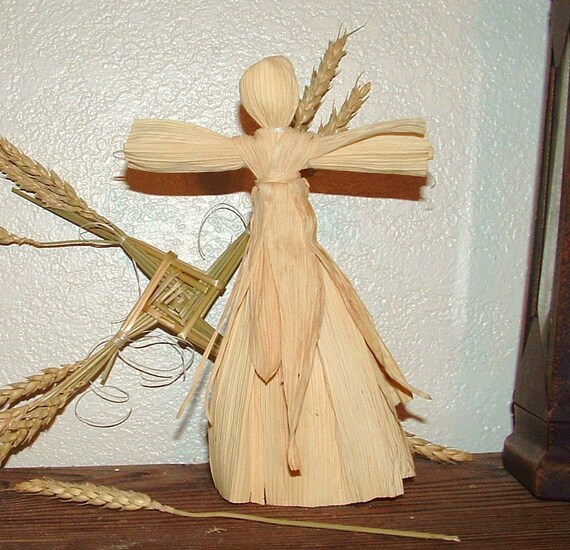
      Theological Thursday: Corn Dollies for Imbolc (craft)

      We talked a bit about Brighid yesterday for Imbolc (hope everyone had a wonderful holiday, by the way!), but I didn't get to go much into one of her many aspects: That of the bride, the symbol of fertility and good fortune. For Imbolc, many Pagans create Brighid dollies; while these are traditionally made of oats and wheat, this version teaches you how to make them using corn husks.


      To make this doll, you'll need some corn husks, cotton balls, string, and some yarn or ribbon. Since you'd be hard-pressed to find corn growing outside this time of year, check your grocery store to obtain the husks. Dried-out ones can be used, but soak them for a few hours first to soften them up and make them more pliable.

      Take a strip of the husk and fold it in half. Place two or three cotton balls in the middle, then twist the husk around and tie off with a piece of string. This makes the head of the corn dolly. Leave a bit of husk at the front and back, below the head, to make the torso.


      Make a pair of arms by folding a couple husks in half and tying off the ends to make hands. Slip the arms between the husks that form the torso and tie the waist securely. If you want your doll with a little more "oomph," add an extra cotton ball or two into the torso to give Brighid a bit of shape.


      To create the skirt, add a few more husks, upside down and overlapping slightly, around the doll's waist. Tie the skirt in place with yarn. It should look like she has her skirt up over her face (ooh, scandalous!). After tying the waist, carefully fold the husks down to create a full skirt. Trim the hem of the skirt so it's even, and leave the doll to dry.


      Once dry, you can leave her plan or give her a face and some hair. I tend to leave mine plain, haha. You can add clothing, too, or beadwork if you desire. Get creative and pull out that crafting box!


      Place Brighid in a place of honor in your home for Imbolc, near your hearth or in the kitchen if possible, and prepare yourself for the abundance she brings!

      (Illustrations courtesy of Patti Wigington at About.com.)

      02 February 2011

      Theological Thursday (a day early): Blessed Imbolc!


      It might not seem like it, but spring is right around the corner. Don't let the piles of snow and threats of freezing rain and sleet fool you, and don't let Punxsutawney Phil tell you otherwise! Today marks the halfway point between the Winter Solstice and Spring Equinox, and is known in the Pagan community as Imbolc.

      Like many Pagan holidays, Imbolc has a Celtic connection to Oimelc, an ancient festival celebrating the birth and freshening of sheep and goats. Otherwise known as the Feast of Milk, the day marks new life about to awaken in the earth, and its preparation to receive seeds and other signs of fertility in the coming weeks until Ostara.


      This connection to Celtic lore also points to the goddess Brighid, or "bright one." In modern Wicca and Paganism, Brighid is viewed as the maiden aspect of the maiden-mother-crone cycle, of fertility and purity, and from Irish lore, she is the keeper of the sacred flame, the guardian of home and hearth. Purification and cleaning are a wonderful way to honor her and to get ready for Spring -- there's a reason why we have the term "spring cleaning"!

      But Brighid was not only known for her youth and vigor; in some parts of the Scottish Highlands, Brighid was viewed as Cailleach Bheur, a woman with mystical powers and older than the land itself. Near Yorkshire, England, she was seen as a warlike figure. And Christians aren't without their own representation of this ancient goddess: St. Brigid was the daughter of a Pictish slave who was baptized by St. Patrick and founded a community of nuns at Kildare, Ireland.


      To recognize and honor Brighid, leave a piece of clothing outside for Brighid to bless, and they will have the powers of healing and protection thanks to Brighid. (You might want to let the article warm up inside a bit before putting it on -- might be a little chilly!) Smoor your fire and rake the ashes smooth before you go to bed, then look for a mark on the ashes when you awake. These could be signs that Brighid has passed that way overnight.

      Hail Brid, Queen of Spring
      Dance with us around the ring
      Mate with Pan your Horned King
      All through the night.


      Hail Pan, Horned One,
      God of greenwood and bright Sun
      Frolic in the dark of night
      By Her light.


      We here your witches serve
      Worship you as you deserve
      Weave a web of strength and might
      Practice your rite.


      By your love so dear
      We progress throughout the year
      Take away our mortal fear
      Give us the sight.


      Hail, Brid, Queen of Spring
      Dance with us around the ring
      Mate with Pan your Horned King
      All through the night.


      Other ancient civilizations celebrated this point between winter and spring, not just the Celts and modern-day Pagans and Wiccans:
      • Lupercalia (Romans) Rather than being associated with a particular temple or deity, Lupercalia was instead focused on the found of the city of Rome by twins Romulus and Remus, feral children who were suckled by a she-wolf in a cave known as the "Lupercale". Purification rituals where a goat was sacrificed and a scourge made of its hide were commonplace during this holiday. Thong-clad men ran through the city, whacking people with bits of goat hide; these people considered themselves fortunate! (To each his own, right?)
      • The Feast of Nut (Egyptialsn) According to the Book of the Dead, the goddess Nut, whose birthday fell on 2 February on the Gregorian calendar, was seen as a mother-figure to the sun god Ra, who was known at sunrise as Khepera and took the form of a scarab beetle.
      • St. Brigid's Day (Christianity) This was already mentioned, but a bit of a story about how St. Brigid came to be: When Ireland converted to Christianity, it was difficult to convince the people to get rid of their old gods, so the church allowed the Irish to worship Bridgid as a saint. 2 February also marks Candelmas for Christians, the feast of purification of the Virgin. By Jewish law, it took forty days after a birth for a woman to be cleansed following the birth of a son, and Candelmas marks the forty days after the birth of Jesus. Candles were blessed, feasting was had, and the drab days of February suddenly seemed brighter.
      Now, I'm not a Pagan big on ritual, save for maybe something around Samhain (and now that's being taken up by our wedding anniversary!). However, after the jump is a ritual you can apply to your own Imbolc celebration, adapted from LadyBridget.com. Feel free to create your own rituals and customs for Imbolc, either using this as an example or starting from scratch.

      ETA: Also, if you're looking for a ritual where you can incorporate your children (or if you're looking for something simpler than a full-on ritual), check out Pagan Dad's post, Happy Imbolc!

      And of course, blessed Imbolc, everyone! Here's to hoping for warm Spring weather in the months ahead! ;)


      Cast the circle in your usual manner.
      Ground and center the participants.
      Bless each person as you normally would.

      INVOKE WATCHTOWERS

      EAST - Hail to thee, Guardian of the Watchtower of the East, the powers of water. We see the sun's rays bouncing off the ocean tides, smashing into the rocks. Our emotions are high as we get ready for Spring, in the anticipation of the Sun's return. Waters of Life, give us birth, and the knowledge to grow as the seeds grow in the Earth from your nourishment. Join the children of the light as we celebrate. So Mote It Be.

      SOUTH - Hail to thee, Guardian of the Watchtower of the South, the powers of Air, you who blow crisp, clean, and cold, with swirls of blistery winds. Bring the warm, soft breezes that herald the beginning of Spring. Smell the sweet scent of lilacs. Breathe in th air. Become refreshed with new thoughs, new knowledge, new projects. Join the cildren of the light as we celebrate. So Mote It Be.

      WEST - Hail to thee, Guardian of the Watchtower of the West, the powers of Fire. Now as we stand in the fullness of winter, yet on the threshold of Spring, we await the seed which is awakening in the Earth. We ask for your Divine spark to ignite our Sacred Fires as we gather this night to rejuvenate the flames of the sun. Join the children of the light as we celebrate. So Mote It Be.

      NORTH - Hail to thee, Guardian of the Watchtower of the North, the powers of Earth. Now the time has come to call for the powers of mountains and of trees, celebrate with us the things that are to be. The warming of Spring will soon bring the abundance of summer. The breezes will be warmer and the days longer. Powers of leaf and flower and thorn, join the children of the light as we celebrate. So Mote It Be.

      INVITE THE HORNED ONE:

      HP: We call upon you O Horned One, at this time of the feast of torches, when every lamp blazes and shines to welcome your rebirth as the Sun. All the land is wrapped in winter. The air is chilled and the Earth lies barren beneath her mantle of sleep. We call upon you to return, Lord of the Sun. The spark of life is within you, as is the darkness of death. For you are the gatekeeper at the end of time. We call upon you whom all must face at the appointed hour. Yet you are not to be feared, for you are brother, lover, and son. You teach us that death is but the beginning of life and we honor you. You who holds the key of life and death. Blessed Be.

      (light the candle for the God)

      INVITE BRIDGET:

      HPS: By the flowers of the field, O Lady of delight, by the crops thy blessings yield, Oh Maiden clear and bright. We evoke thy presence in kernels and sheaves. We see thy face in the moonlit leaves. Come now to us, extend thy grace, come into our circle within this holy place. Daughter of the Earth, drinking sunlight. Queen of plants, sister of night. By leaf and twig, by root and bough, by water and earth. Come to us now! Bring us your grain, the staff of our lives. Bring us your fruit, wherever it thrives. Mistress of herbs unlock your power and lead us into your leafy bower. In love and joy we call your name, with comforting hope, you ease our pain. We see thee in the swelling bud, we feel thy stirring in our blood. O Lady clear, we feel thee near. In Spring a Maiden with flowers crowned, in summer and harvest, the Mother renewed, in fall and winter the Hag holds sway, yet the Maiden remains but months away. Great Triple Goddess, the seasons flow and eff to thy will as you come and go. Blessed Be.

      (light the candle for the Goddess)

      THE MYTH

      Narrator - As the scene unfolds, we find Persephone in the underworld having been abducted by Hades to be his Queen. Demeter, in her grief has allowed the earth to be barren. Zeus, taking pity on humankind's suffering, sends Hermes to the underworld to tell Hades to free Persephone. Having overheard the conversation, Persephone confronts Hades.....

      Persephone - I, Persephone, have heard the voice of Hermes, messenger of Zeus. I have heard him command you to set me free. And indeed, I am fully ready to go. I, who am the flower of Maidenhood and delight in the newness of life, yet will I ever be burdened with the memory of the restful sadness that is your realm. Forever I will see the shadow of the dying flower even in the fullness of it's bloom.

      Hades - (aside) If I can get her to eat some of these seeds, she must return to me.
      (to Persephone) My Lovely Queen, my love for you is so strong that I would risk the wrath of my brother, Zeus, and of Demeter, by bringing you here. Please don't leave me for I am only the reaper. I free the old, the tired and torn so that She can make them fresh and whole again. Death is a thing in which to rejoice, for after Death comes renewal. In me they find rest and peace. But if you must leave me, please my Lady, have this for your journey. (holding out closed hand)

      Persephone - I will take only a token bit to acknowledge your hospitality, and then I shall be gone. (Eats one bite)

      Demeter - Children. light your candles so that my daughter may find her way.

      (At this point, Demeter lights her candle from the God and Goddess candles on the altar, then goes to the person in the West and lights theirs. Each person lights the candle of the person next to them, and as the light travels deosil around the circle, Persephone slowly comes along following the light. When she reaches the end, she greets Dememter with a hug and kiss. They murmer greetings and such until suddenly Demeter exclaims in a very loud voice....)

      Demeter - YOU ATE WHAT?

      Persephone - It was only a few seeds!

      Narrator - Persephone was told not to eat anything in the underworld or she would not be able to return above. But Persephone ate a few pommegranate seeds. Zeus decreed a compromise for the sharing of Persephone. She must return 3 months of the year to the underworld to reside with her husband, with the remainder of the year to be spent with her mother in the land of the living.

      HPS - Behold the three-formed Goddess, she who is ever three, Maid, Mother, Crone. Yet She is ever one. We welcome now the Maiden Persepnone. For without spring there can be no summer, without summer, no winter, and no new spring. Thus we look forward to the end of winter. We lit the candles to light the way for Persephone's return from the darkness, and to lend strength to the Sun as He grows in power. Blessed Be.

      (People can extinguish their candles and take them home, or leave them lit on the altar, if there is space, or around the circle if that is possible.)

      (At this time, pass around the parchment paper and pens so everyone can write what spiritual goals they wish to reach during the coming year. These are place in Brid's Bed, or can be burned to send the wished to the Goddess. They should first be charged, by raising energy while each person holds their paper, either through dance and chanting, humming, or meditation channeling, or whatever your group does. Then each person will either put the parchment in and tell Brid what she desires, or put into the Cauldron to be transformed and burned.)

      (Also this is the time, if you wish, to charge seeds for the spring planting later. Herbs and flowers are appropriate, get ones that grow in your area so your participants can plant them. We also bless our candles now, one of each color, to be used during our magickal year. A few drops of wax from these candles will add the Goddess energy and blessing from this Sabbat to whatever candles we dress. Or people can simply use the white candles they lit for Persephone's return, since white contains all colors within it. Charging is done as above.)

      GREAT RITE (Perform in your usual manner)

      DISMISS WATCHTOWERS

      EAST - Hail to thee Guardian of the Watchtower of the East, the powers of Water. We felt your presence this evening as you washed away the winter's chill. Stay with us as we grow in the coming months. Continue to water our plants and our minds so they grow to be strong and healthy. As ye depart to your mighty realms, we bid thee Hail and Farewell, and harm ye none on your way. So Mote It Be.

      SOUTH - Hail to thee Guardian of the Watchtower of the South, the powers of Air. We thank you for the truning of the seasons, the cold of winter, the growth of spring, and fall harvests. As you leave us, leave us with new inspiration for the new spring. As you depart to your mighty realms, we bid thee Hail and Farewell, and harm ye none on your way. So Mote It Be.

      WEST - Hail to thee Guardians of the Watchtower of the West, the powers of Fire. We thank you for the smoldering embers that have lain dormant through the winter and are now on the verge of flaring forth into flowering spring. We thank you for your participation and your protection. As you depart to your mighty realms, we bid thee Hail and Farewell, and harm ye none on your way. So Mote It Be.

      NORTH - Hail to thee Guardian of the Watchtower of the North, the powers of Earth. The powers of mountains and trees, you have celebrated with us the things that are to be. Powers of leaf and of thorn, we look forward to longer days and warmer days. We thank you for joining us in our rites. As you depart to your mighty realms, we bid thee, Hail and Farewell, and harm ye none on your way. So Mote It Be.

      CLOSE CIRCLE.

      Contact Form

      Name

      Email *

      Message *